

You do not need to prove whether a career concern is intuition or anxiety before checking it. Name the concern, separate observations from assumptions, and seek information that could change your decision.
Feeling calm is not a truth test, and feeling worried does not cancel a real workplace problem. Use your impressions alongside job terms, practical priorities and support appropriate to the situation.
Turn a feeling into a question you can check
| Concern | Known observation | Useful next question |
|---|---|---|
| The hours may not work | The interviewer mentioned late calls | How often are evening hours expected? |
| I may not be ready | This is my first supervisory role | What training and support are included? |
| The move feels risky | Relocation costs are unclear | Which costs and arrangements can be confirmed? |
| I need certainty | Important details remain unanswered | Which missing answer could change my choice? |
Scroll sideways to see the full table.
Intuition Vs. Anxiety
You might have been taught that intuition always comes calmly, and anxiety feels repetitive or scary. This difference can sound reassuring, but it’s not a test. A real concern can cause fear, and an unsupported idea can feel calm or certain.
People are also different, and they experience emotions differently. Stress, experiences, health, tiredness, and how important the decision is can influence how a person reacts. The intensity of a feeling does not establish whether the impression is accurate.
Instead of just asking if it makes you feel peaceful, ask what the feelings are referring to. Are these feelings connected to a certain statement that happened during an interview, an unknown financial situation, or an imagined outcome?
You can look at the situation before you make a decision. A concern about unclear working hours can lead to questions about the hours. This doesn’t mean that you have to prove your concern was intuition or anxiety.
Understanding Anxiety
Some people worry before a career change, and this is normal. A new role can affect your income, relationships, and your daily life. Feeling uncertain doesn’t mean that you have an anxiety disorder or that an opportunity isn’t right for you.
The National Institute of Mental Health's guide to generalized anxiety disorder distinguishes occasional worry from persistent, difficult-to-control anxiety that interferes with life. It also describes symptoms such as sleep problems, tension, and difficulty concentrating.
There are some symptoms that need to be considered if they’re persistent, but they’re not a checklist to decide if a certain job is safe. Someone can experience stress and still see a real workplace problem. The fact that there’s worry doesn’t cancel out the facts.
Don’t tell yourself that you have to feel completely calm before you make a good choice. Some decisions have uncertainty, and the aim is to make sure the decision has enough information in support, not to get rid of every uncomfortable sensation.
Check a Career Concern: visual guide
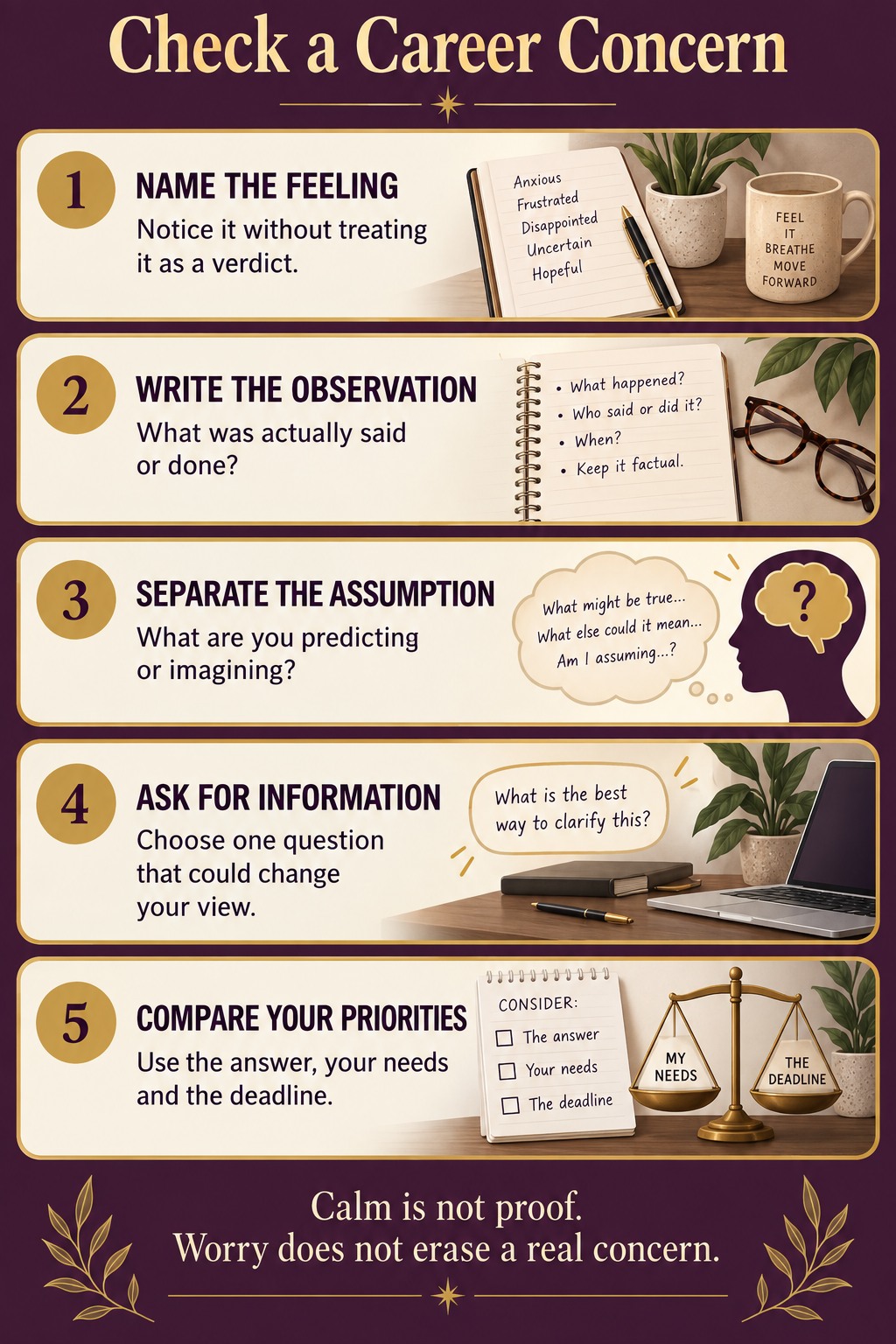
Read the infographic as text
- 1. NAME THE FEELING: Notice it without treating it as a verdict.
- 2. WRITE THE OBSERVATION: What was actually said or done?
- 3. SEPARATE THE ASSUMPTION: What are you predicting or imagining?
- 4. ASK FOR INFORMATION: Choose one question that could change your view.
- 5. COMPARE YOUR PRIORITIES: Use the answer, your needs and the deadline.
Write Down What Actually Happened
Start by writing down what actually happened without adding what you think it means yet. For example, you might write, “The interviewer gave me two different answers about working weekends,” or “I have never managed a team this large.” Keeping it simple can help you separate what you know from what you are worried might be happening.
Next, write down what you think it could mean. You might think, “Maybe they are not being honest about how often I will have to work weekends,” or “I am worried that I will not be able to handle this job.” Your concern could turn out to be right, but it is still different from what you actually know. Separating the two can help you figure out what you need to learn before making a decision.
Then think about what decision you are actually trying to make. Do you need to ask another question, accept the job, negotiate something before accepting it, or decide if it is time to leave your current position? Sometimes everything can start to feel overwhelming when you are trying to answer several different questions at once.
Writing things down can help you see what information you are missing and what you can do next. You do not have to keep going over the same situation again and again trying to find something you missed. If writing about it starts making you more confused or worried instead of giving you clarity, stop and focus on one thing you can actually do next.
Give the Concern a Specific Subject
Saying, “This job has bad energy,” might describe how you honestly feel, but it does not necessarily tell you what is making you uncomfortable. Try finishing the sentence, “I am concerned that…” and see what comes to mind.
You might realize that you are worried about an unpredictable schedule, the way a manager answered one of your questions, a long commute, or how the job could affect your family responsibilities. Once you know what is bothering you, you can look more closely at that particular issue and decide how important it is to you.
Sometimes you still might not be able to explain exactly why something feels off. You do not have to make up a reason just to justify your feelings. You can admit that something is making you uncomfortable and give yourself more time to learn about the situation if you have that option.
At the same time, try not to turn a feeling into a fact about another person. Feeling uncomfortable around a manager does not automatically mean that the manager is lying to you, and getting a bad feeling about a coworker does not mean that person plans to hurt you. Pay attention to what people actually say and do while still giving yourself permission to notice how those interactions make you feel.
Ask What Information Would Change Your Mind
Once you know what is worrying you, think about what information could help you understand the situation better. If you are concerned about the workload, ask about things like normal working hours, staffing, deadlines, and what happens when something urgent comes up. If you are worried that the position might not be a good fit, ask exactly what your responsibilities would be and what kind of support or training you would receive.
It can also help you to know what kind of answer you need before you ask the question. For example, if you are concerned about traveling for work, you might need to know how many times a month employees normally travel instead of simply being told, “We are pretty flexible.” A specific answer gives you something you can actually compare with what you want and need.
Also think about what could make you see the situation differently. If you believe the workload will be too much, is there an answer the employer could give that would make you feel better about it? Being open to new information does not mean ignoring your instincts. It simply means giving yourself a chance to find out if your first impression still makes sense once you know more.
You probably will not be able to get an answer to every question, and that is okay. Instead of filling in the missing pieces with either the best possible story or the worst one, recognize what you still do not know. Then you can decide if you are comfortable moving forward with the information you have.
Look at the Thoughts Over the Feelings
According to the NHS guide to reframing unhelpful thoughts, it encourages considering evidence and alternative perspectives. Applied cautiously to a career question, that means examining a thought such as “One mistake will end my career” rather than simply commanding yourself to stop worrying.
A better statement can be: “This role involves learning, and I can ask what kind of support is available to me.” This doesn’t guarantee success, and it replaces predictions with a question that has real conditions.
Don’t just force a good interpretation when there’s evidence of harm. Reframing shouldn’t be an instruction to put up with threats, discrimination, unsafe work practices, or broken agreements.
The purpose is accuracy and proportion. You might end with a better view, a cautious view, or recognize that you need more information before you make a decision.
Options Vs. Priorities
A job can sound exciting and still be unsuitable for your life. Look at the requirements that matter the most, such as income, travel, learning opportunities, accessibility, and time with family or a certain kind of work.
Separate requirements from preferences. You might want a short commute but need a schedule that’s compatible with a caregiving situation. Having a clear distinction can help you avoid treating each trade-off as a serious warning.
Compare the opportunity with those priorities using what is known. Don’t just think that a prestigious title allows you to ignore an unmet requirement, and don’t think that having discomfort means the job is impossible.
Your priorities are allowed to change. If a role fits you now but didn’t fit you years ago, that doesn’t mean your earlier judgment was wrong. A good decision shows that you’re living this life now.
Getting Information
Before you make a big commitment, look for an action that can show you something. You might want to speak to a future colleague or ask for a clear job description.
If you’re thinking about a career change, having a conversation or taking an introductory course might help you understand the field better. Check the costs and scope before you ever make a commitment. An experiment should help to lessen uncertainty without creating a level of risk that is the final decision.
Figure out what you want to learn from this step. Ask yourself if you would enjoy the work and how much of the week involves client calls. These give the enquiry a specific purpose; the answers may still require investigation.
Afterwards, update your view. Don’t keep getting information just to avoid making a decision, and don’t ignore a good answer because it conflicts with a reading or a first impression.
An Example of a Concern Worth Checking
Natalie feels a little uneasy after interviewing for a job that was described as flexible. During the interview, the manager mentions several times that employees need to be available late at night. At first, Natalie wonders if her intuition is trying to warn her that something about the job is not right.
Instead of immediately deciding that the feeling is a warning, she thinks about what actually bothered her during the interview. She realizes that the repeated comments about working late are what stood out the most, so she asks the manager to explain the expected working hours in writing. She finds out that working evenings is actually a regular part of the position, which would interfere with a commitment she cannot change.
Natalie decides to turn down the job because the schedule does not work for her. She does not have to figure out if her original feeling was intuition or simply something she noticed during the conversation. She also does not have to assume that the employer was trying to hide anything from her. What matters is that something made her stop and ask more questions, and those answers helped her make a decision that worked better for her life.
The same would be true if Natalie had gotten a really good feeling about the manager and the job. Liking the people she met would not change the fact that the schedule did not work for her. Her feelings helped her notice something that deserved more attention, but the information she received helped her make the final decision.
Examples of Feeling Unsure About a New Challenge
Ethan is offered his first job as a supervisor, but instead of immediately feeling excited, he starts worrying that he will disappoint everyone. He keeps thinking about everything that could go wrong during his first few weeks, even though he cannot point to anything specific about the job that seems like a warning sign.
Before making his decision, Ethan asks more questions about the training he will receive, how many people he will supervise, what responsibilities he will have when he first starts, and how his performance will be evaluated. He also thinks about the experience he already has and talks with someone who knows his work and can give him another perspective.
Getting those answers does not suddenly make all of Ethan’s nervousness disappear. It does give him a better idea of what the job will actually involve and if he will have enough support while learning the new position. From there, he can decide if he wants to accept the job, ask for something to be changed, or turn it down.
This does not mean that someone should always accept an opportunity just because their fear might come from being nervous about something new. The point is to look at what is actually causing the concern and learn as much as you can before deciding. You can pay attention to your feelings without letting either fear or excitement make the entire decision for you.
Keep Your Psychic Reflections
If you decide to get a career reading, ask a question about your own situation or your own assumptions. You could say something like, “What am I overlooking in how I think success affects me?” This can allow you to reflect without pretending to give you a future guarantee.
Write down any good ideas you interpret. Ask whether it connects to something you can observe or look deeper into. A suggestion that you need more information might let you make decisions with authority.
Don’t keep buying a bunch of readings until the readers all agree with one another. Agreement between readings doesn’t mean a guaranteed outcome, and a disagreement can become an expensive source of trying to find certainty.
Don’t resign, invest, or reject care because a reading predicts that you’ll be successful somewhere else. A good spiritual experience can give you time to reflect, while practical commitments still require reliable information and appropriate advice.
Decision Deadlines
Find out if a response is really required. Feeling that you have to decide right away can add pressure beyond what’s happening in the situation. If you need time to look at an offer, ask if a reasonable extension is possible instead of just thinking that asking is going to ruin your opportunity.
Use the time you have available to answer the questions that are most important to you. Repeatedly thinking about every possible future possibility is different from looking at the contract terms or talking about a scheduling need. Pick the information that could change the decision.
When the deadline comes, pay attention to what stays uncertain. A good choice might still involve a risk, and a later hardship doesn’t automatically prove that you ignored your intuition. Judge the process by the information in front of you and the options that are available at the time and then change when your situation changes.
It can be helpful to write down a brief decision note that explains your reasons. Keep the facts as the facts, because the purpose is to look at the context, not to create a document you’ll use to punish yourself later if the outcome isn’t perfect.
Final Thoughts: Getting Extra Support
If career worry is keeping you up all night, making it hard for you to concentrate or deal with your relationships, think about talking to a qualified professional. You don’t have to wait until you can prove whether every concern is rational before you get help.
The NIMH overview of psychotherapy explains that treatment can help people address troubling thoughts, emotions, and behaviors. A clinician can work with distress while respecting that spiritual beliefs may be part of your life.
If you’re dealing with workplace safety or rights issues, get local professional help, workplace, union, or other kinds of support. Emotional support and good advice can work together to look at different parts of the problem.
You might not label a certain impression with certainty, but what you can pay attention to is what can be checked, compared, and used as a next-step action. Using this process allows your intuition to shine without allowing stress or spiritual interpretation to carry the whole decision.
For translating a reflective reading into a practical next step, see our career reading action-plan guide.
For the next step, explore personal growth and professional goals.
Frequently asked questions
1. Can I reliably label a feeling intuition or anxiety?
Not from its emotional tone alone. It may be more useful to identify the concern and check what information supports or challenges it.
2. Is intuition always calm?
No dependable rule makes calm feelings correct and fearful feelings incorrect. Either can occur alongside accurate or mistaken impressions.
3. Does worry mean an offer is unsuitable?
Not automatically. A new opportunity can feel uncomfortable. Compare the actual responsibilities, support and terms with your needs.
4. Can anxiety coexist with a real workplace problem?
Yes. Feeling anxious does not invalidate observations about threats, unclear terms or broken agreements. Assess the circumstances as well as the feeling.
5. What should I write down first?
Record what happened in plain terms, such as two different answers about weekend work. Put your interpretation in a separate line.
6. What question could help with unclear hours?
Ask for expected hours, evening or weekend frequency and how urgent work is handled. Specific answers are more useful than a broad promise of flexibility.
7. What if I worry about being unqualified?
Compare the role with your experience and ask about training, supervision and early expectations. You do not need all nervousness to disappear first.
8. How do I separate a need from a preference?
A need is a condition the role must meet, such as a workable caregiving schedule. A preference is something you would like but may trade against other benefits.
9. What information would change my mind?
Identify an answer that could alter your view before asking. This helps prevent dismissing useful information simply because it differs from your first impression.
10. What if I still cannot explain the feeling?
Acknowledge the uncertainty without inventing an accusation. If time allows, gather relevant information and notice whether the concern becomes more specific.
11. Can I ask for more decision time?
You can ask whether an extension is available. The employer may or may not agree, so confirm the actual deadline rather than assuming it.
12. Should a career reading decide for me?
No. It can be optional reflection, but decisions should use the job terms, your circumstances and appropriate advice.
13. How do I avoid endless reassurance seeking?
Choose the questions that matter, a stopping point and a decision date. Pause repeated readings or checking that no longer adds information.
14. When should I seek help for worry?
Consider qualified support when worry persists or interferes with sleep, concentration or daily life. You do not have to resolve every career uncertainty before asking for help.
15. What belongs in a decision note?
Record the facts available, priorities, unresolved issues and reasons for your choice. Use it for context rather than blaming yourself if the outcome later changes.