

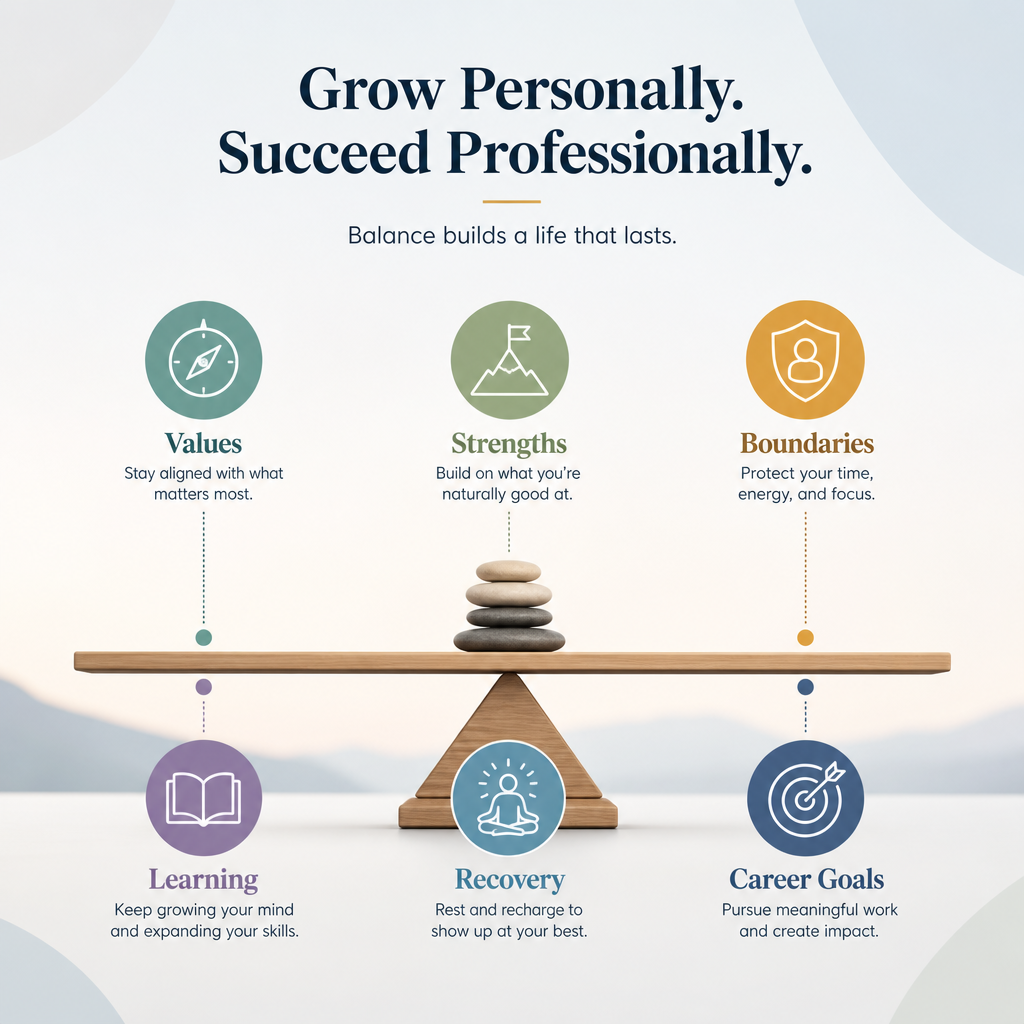
Professional success is easier to sustain when it grows with the rest of your life rather than consuming it. Skills, income, promotions, and recognition matter, but so do health, relationships, values, identity, and the ability to recover from stress. Personal growth and career growth are not competing projects. At their best, they strengthen each other.
Redefining Success
A useful definition of success includes both outcomes and sustainability. A role can look impressive from the outside and still be a poor fit if it repeatedly conflicts with your values, health, or important relationships. Ask not only “Can I succeed here?” but also “Can I live well while succeeding here?”
Personal Growth Improves Professional Performance
Self-awareness makes it easier to recognize strengths, triggers, communication habits, and blind spots. Emotional regulation helps during conflict. Curiosity makes learning easier. Boundaries protect attention. These are personal capacities, but they show up directly in leadership, teamwork, decision-making, and resilience.
Build a Growth Mindset Without Turning Life Into a Project
A growth mindset means believing skills can improve through effort, practice, feedback, and experience. It does not mean every weakness needs to become a strength. Choose a few areas that matter to your goals and give yourself permission to be average at things that are not important.
Use Experience as Data
Setbacks, changes, difficult managers, financial pressure, and failed plans can all reveal information. Ask what the experience taught you about the kind of environment you need, how you respond under stress, and which skills or boundaries would help next time.
Clarify Your Values
Write down five values that matter most in work: stability, creativity, autonomy, income, flexibility, service, learning, status, collaboration, or something else. Rank them. A role does not have to satisfy every value, but repeated conflict with your top values often explains why a seemingly good career feels draining.
Align Professional Goals With Those Values
Turn values into practical criteria. If flexibility is essential, define what it means in hours, location, or autonomy. If growth matters, ask what skills you will gain in the next year. If stability matters, review the employer, industry, compensation, and role structure. Use those criteria when reviewing your career goals.
Build on Strengths
Notice the work that consistently feels both effective and energizing. Your strengths may include communication, analysis, empathy, organization, creativity, negotiation, leadership, or technical expertise. Look for roles where those strengths are useful instead of spending all your development time trying to repair weaknesses.
Protect Mental and Emotional Bandwidth
Ambition becomes difficult to sustain when there is no recovery. Protect sleep, movement, relationships, and time that is not monetized. A boundary such as no work email after a certain hour can be more valuable than another productivity system.
Use Feedback and Mentorship Well
Ask for feedback that is specific enough to act on: what should I keep doing, stop doing, or do more consistently? A mentor can also help you distinguish between a temporary hard season and a role that no longer fits. For changing industries, review practical career planning before making a leap.
Develop Emotional Intelligence
Strong workplace relationships depend on noticing your own emotions without letting them automatically dictate behavior. Pause before reacting, ask clarifying questions, listen for what the other person means, and address conflict while it is still manageable.
Create a Work-Life System, Not a Perfect Balance
Balance changes by season. A launch, deadline, or training period may temporarily require more work. The important question is whether intensity has an end point and whether recovery follows it. If “temporary” overwork has become permanent, the system needs adjustment.
Stay Adaptable
Industries change with technology, economics, automation, and consumer behavior. Keep one part of your development plan focused on adaptability: a new tool, certification, portfolio project, cross-functional responsibility, or professional community.
Use Spiritual Guidance Carefully
If you include intuition or psychic guidance in career decisions, use it as a reflective tool rather than a guarantee. Questions that help you explore values and fears can be useful; concrete decisions should still consider finances, qualifications, labor conditions, and evidence. Our guide to career guidance can help frame better reflective questions.
A Monthly Sustainable-Success Review
Once a month, ask four questions: What is growing? What is draining me? What am I learning? What needs to change next month? One small adjustment made regularly is often more sustainable than waiting for a crisis before redesigning your work life.
Final Thoughts
Professional success is not weakened by personal growth. It becomes more durable when your goals, strengths, values, and well-being are aligned. The objective is not to remove every stressful period. It is to build a career that can develop without requiring you to disappear inside it.
Frequently Asked Questions
1. What does balancing personal growth and professional success mean?
It means developing your career while also protecting the values, relationships, health, identity, and learning that make success sustainable.
2. Can career ambition and work-life balance coexist?
Yes. Balance is not equal time every day; it is a sustainable system with boundaries, recovery, and intentional periods of higher effort.
3. How do personal values affect career choices?
Values help you judge whether a role fits what matters most to you, such as stability, autonomy, creativity, flexibility, service, or income.
4. How do I identify my work values?
List what you need from work, rank the items, and notice which past jobs felt energizing or draining and why.
5. Why are strengths important for career success?
Using strengths can improve confidence, engagement, and performance while helping you choose roles where your natural abilities are useful.
6. Should I fix every professional weakness?
No. Improve weaknesses that materially limit your goals, but invest heavily in strengths and high-value skills.
7. What is a growth mindset at work?
It is the view that skills and performance can improve through practice, feedback, learning, and experience.
8. How can setbacks support personal growth?
Setbacks can reveal gaps in skills, boundaries, communication, expectations, or role fit when you reflect on them constructively.
9. How often should I review my career goals?
A brief monthly check-in and a deeper quarterly or annual review can help keep goals aligned with changing circumstances.
10. What is emotional intelligence at work?
It includes recognizing emotions, regulating reactions, listening well, understanding other perspectives, and communicating constructively.
11. How do I know if my career is harming my well-being?
Warning signs can include persistent exhaustion, loss of identity, chronic boundary violations, sleep disruption, and strain across important relationships.
12. Can I be successful without working long hours?
Many roles reward outcomes, expertise, judgment, and consistency rather than maximum hours. The answer also depends on the industry and role.
13. How can a mentor help my career?
A mentor can offer perspective, feedback, industry context, introductions, and help you see options you may overlook alone.
14. What should I do if my values no longer match my job?
Identify the specific mismatch, explore whether the role can be adjusted, and build a realistic transition plan if it cannot.
15. How do I make professional goals more sustainable?
Break them into measurable steps, set limits on workload, schedule recovery, and review whether the goal still fits your priorities.
16. How should I prepare for industry changes?
Keep learning, follow credible industry sources, build transferable skills, maintain professional relationships, and update your portfolio or credentials.
17. Is personal fulfillment the same as career success?
No. They can overlap, but fulfillment also comes from relationships, health, creativity, community, and life outside work.
18. Can a psychic tell me which career to choose?
Psychic guidance should not be treated as a guarantee or substitute for research, financial planning, qualifications, or professional career advice.
19. What is a good monthly career-review question?
Ask what is growing, what is draining you, what you are learning, and what one change would make next month more sustainable.
20. What is the main goal of balancing growth and success?
The goal is a career that develops your skills and opportunities without repeatedly sacrificing the rest of your life.